mariano sardón

<-- OTHER WORKS bio short bio contact español

"Chromatic Change"


The surface of an object partakes of the color of the light which illuminates it; and of the color of the atmosphere which lies between the eye and that object, that is of the color of the transparent medium lying between the object and the eye; and among colors of a similar character the second will be of the same tone as the first, and this is caused by the increased thickness of the color of the medium lying between the object and the eye.

Leonardo Da Vinci, OF THE COLOR OF THE ATMOSPHERE.: 306.
1487 -- 1490.


Of various colors which are none of them blue, that which at a great distance will look bluest is the nearest to black; and so, conversely, the color which is least like black will at a great distance best preserve its own color. Hence the green of fields will assume a bluer hue than yellow or white will, and conversely yellow or white will change less than green, and red still less.

Leonardo Da Vinci, OF PAINTING.: 307.
1487 -- 1490.
[1]


Leonardo da Vinci explored color perspective in close relation to the atmosphere, observing how distance, density, dust, smoke, and altitude affect color perception, as noted in his Notebooks VI. His experiments aimed to help painters understand how colors shift with atmospheric conditions over distance. Leonardo revealed that perception is never separate from the atmosphere that carries it.
Centuries later, the air has changed—and so, perhaps, has our vision. Pollution has slowly rewritten the palette of the world, intensifying sunsets into rose and violet hues while veiling others beyond recovery. During the quiet of the COVID-19 lockdowns, a rare clarity returned: skies deepened into an unfamiliar blue, reminding us that color is not fixed, but shaped by the invisible conditions through which we look.

I wonder how the color perception changed since those Leonardo's times?

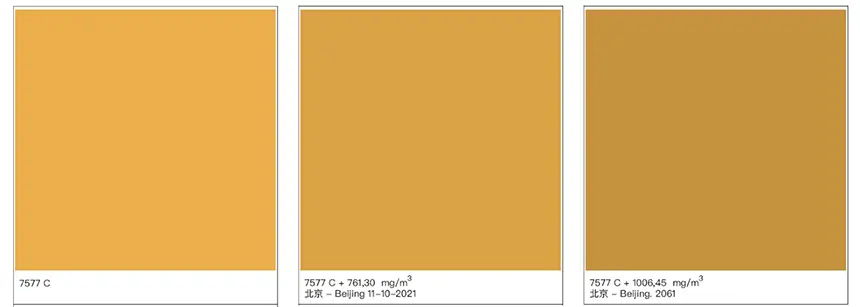
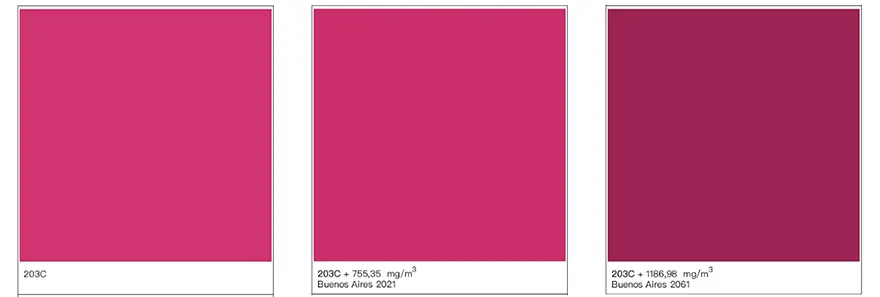
"Chromatic Change" is a series of monochrome paintings in which Pantone colors are systematically modified by adding the measured amount of carbon per cubic meter to each tabulated color code.
Each painting corresponds to a specific city on a specific day, incorporating both recorded and predictive air-pollution data extending decades into the future.


Data from GEOS-5 / GMAO / NASA satellites traces the invisible composition of the air, measuring carbon and airborne micro-particles across the planet through global atmospheric and weather visualizations. This data reveals the fluctuating presence of greenhouse gases anywhere on Earth. [2], [3]. Atmospheric particles subtly alter perception, challenging the neutrality of standardized color systems like Pantone for example!.


Pollution particles data and paintings.

Paintings are made in acrylic on canvas. The amount of powder color pigment for covering the 1 x 1 m canvas is altered by the addition of precise mg of diluted soot into the same amount of acrylic medium.
All the amount of greenhouse gases values are taken from Earth global Weather conditions visualization, usually provided by GEOS-5 / GMAO / NASA satellites.

Particles to be considered in the calculus:
PM1 < 1 μm (less than 1 micro size).
PM2,5 < 2,5 μm (less than 2,5 micro size).
PM10 < 10 μm (less than 10 micro size).

Chemical compounds:
Carbon Monoxide (CO).
Carbon Dioxide (CO2).
Nitrogen Dioxide (NO2).
Sulfur Dioxide (SO2).

The total amount of such elements or a particular city are added and calculated in mg/m3.
Predictive future amount of pollution is interpolated according chart values provided by NOAA Global Monitoring Laboratory according to The Annual Greenhouse Gas Index.


Notes about atmospheric pollution.

Since data monitoring by NOAA Global Monitoring Laboratory, CO2 is 504 ppm in 2020 (755 mg/m3), when my daughter will be my age in 2060, the CO2 will be 670 ppm (1170 mg/m3) if everything continues equal and no changes are made. [4]
Additional different size particles, Freon gasses CFC, Carbon monoxide (CO), Ozone (O3), Nitrogen Dioxide (NO2) and Sulfur Dioxide (SO2), methane (CH4) have to be added in higher concentrations last year. And overall, Indoor pollution is 10% more.
Air pollution increases the risk of suffering from various acute diseases, such as pneumonia, or chronic diseases such as cardiovascular diseases or lung cancer. According to the Argentine Toxicological Association, eighty five children die in Argentina annually because of breathing polluted air [5] . People exposed for years to air with a high level of particulate matter are at increased risk of cardiovascular disease and cancer, according to the WHO. [6]
The indoor air is 10 times more polluted than the outdoor air. Indoor air pollutants are even more damaging than outdoor pollutants. The reason is constrained areas provide a more favorable environment for pollutant build-up as compared to the outdoor areas. Many people are unaware of the fact that indoor air pollution makes you look older as it has a detrimental effect on your skin. Prolonged exposure to indoor air pollutants weakens the immune system, impairs your lungs, and also makes them more susceptible to infection and diseases.
It was initially recognized that climate change would affect the global economy and infrastructure. The climate crisis is already a health crisis too. [7]


Leonardo's experiment tried to reflect about the colors at a distance with the influence of sun and atmosphere and he observed changes in color pale according to distance for painting techniques.


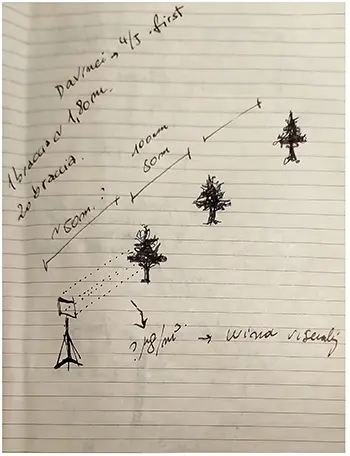
Since Leonardo: How Painter Should Carry Out The Perspective of Color in Practice .

"In order to put into practice this perspective of the variation and loss or diminution of the essential character of colours, observe at every hundred braccia some objects standing in the landscape, such as trees, houses, men and particular places. Then in front of the first tree have a very steady plate of glass and keep your eye very steady, and then, on this plate of glass, draw a tree, tracing it over the form of that tree. Then move it on one side so far as that the real tree is close by the side of the tree you have drawn; then colour your drawing in such a way as that in colour and form the two may be alike, and that both, if you close one eye, seem to be painted on the glass and at the same distance. Then, by the same method, represent a second tree, and a third, with a distance of a hundred braccia between each. And these will serve as a standard and guide whenever you work on your own pictures, wherever they may apply, and will enable you to give due distance in those works. [14] But I have found that as a rule the second is 4/5 of the first when it is 20 braccia beyond it."


We can repeat the color experience as if we were Leonardo in the XXI century where atmospheric pollution is different from Leonardo’s times. The visibility affected by our polluted atmosphere depends on the place, city where we are.